
Telling a Story That Blooms Beyond the Field

An Interview with Vanessa of Tulip Valley Farms
At Tulip Valley Farms, storytelling isn’t just something shared—it’s something lived. In this conversation, Vanessa shares how her family’s unique journey, including her brother Andrew’s experience as a colorblind tulip farmer, has blossomed into a powerful and authentic way to connect with guests. From children’s books to merchandise and meaningful community outreach, their story continues to grow in unexpected and inspiring ways.


A Story Guests Instantly Connect With

One of the most compelling parts of Tulip Valley Farms’ story is also the most unexpected.


Vanessa shares that her brother Andrew—a tulip farmer—is colorblind. It’s a detail that immediately captures attention. Tulip farming is so deeply rooted in color, yet Andrew navigates it differently. That contrast sparks curiosity and relatability.


Many guests either experience colorblindness themselves or know someone who does. What might seem counterintuitive at first quickly becomes meaningful: a reminder that limitations don’t always define outcomes.


Creative Storytelling in Action

Tulip Valley Farms has found thoughtful and creative ways to bring their story to life:

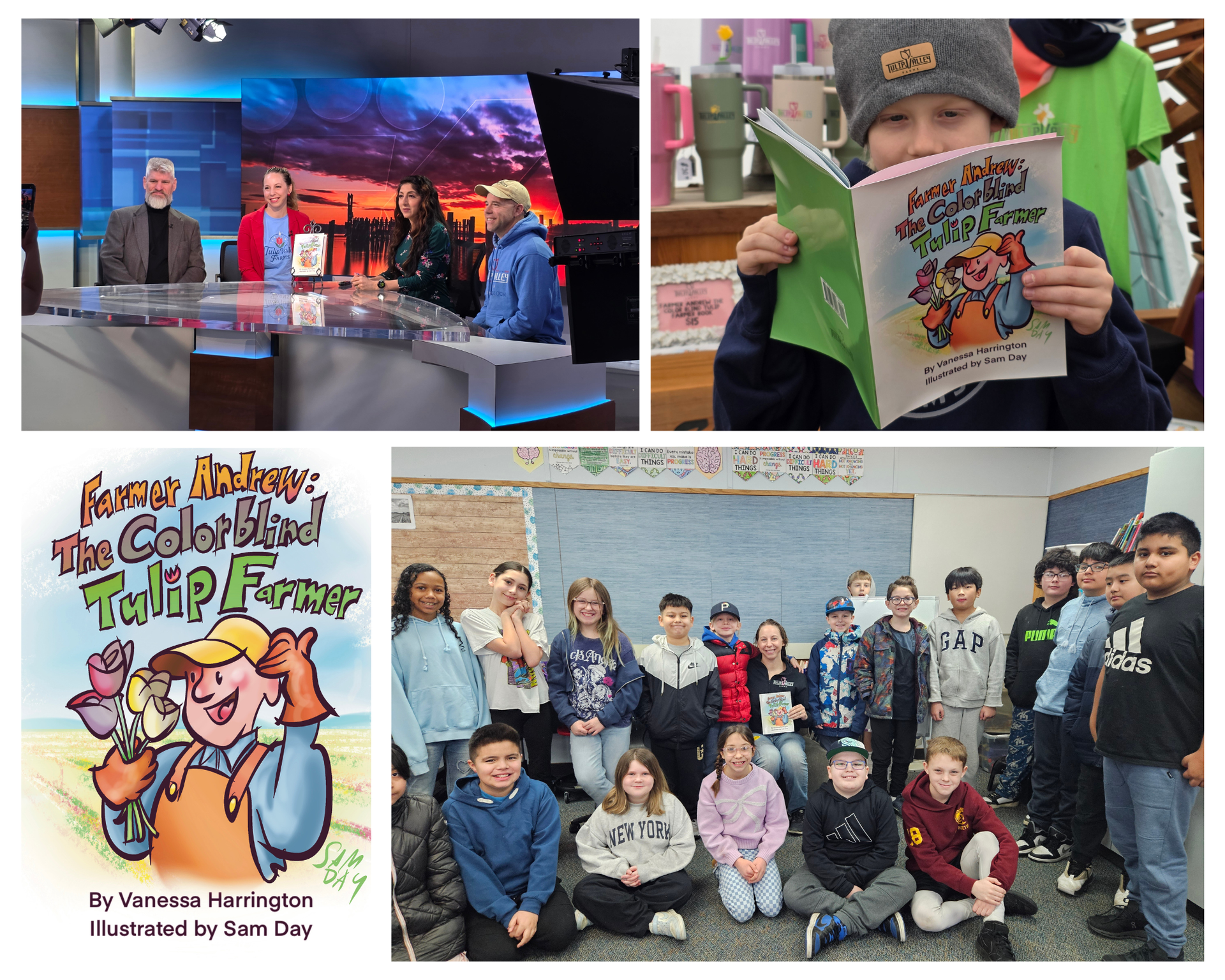
  • Children’s Book – Vanessa wrote a book inspired by Andrew’s journey, creating a new way for families to engage with their story.
  • “See the World Differently” Merchandise – Stickers and shirts extend the message beyond the farm.
  • Media Appearances – Vanessa, Andrew, and the illustrator appeared live on a weekend news program, sharing their story with a broader audience.
  • Community Engagement – From a public reading and book signing event to visiting a 4th-grade classroom, they’ve brought the story directly to children.


Each of these efforts reinforces their message in a tangible, memorable way.


Why Their Story Resonates

At its core, the story isn’t just about tulips—it’s about perspective.


Vanessa explains that guests connect deeply with the idea that:

  • Being “different” doesn’t mean being limited
  • Challenges can be navigated with support
  • Seeing the world differently isn’t wrong—it’s simply different


That authenticity has turned casual visitors into something more meaningful: true fans of the farm.


Gaining Attention Through Authentic PR

Tulip Valley Farms has seen strong success with storytelling-driven media coverage.

  • The story of a colorblind tulip farmer gained widespread traction, being syndicated across 70 regions.
  • The children’s book provided a fresh angle, helping reignite media interest and expand their reach.


By evolving the narrative rather than repeating it, they’ve kept their story relevant and engaging.


Evolving the Story Year After Year

Vanessa and her family continue to build on their story in meaningful ways:

  • Year One: The colorblind tulip farmer story emerges
  • Year Two: A children’s book brings it to life
  • What’s Next? Possibly a series—or new stories altogether


One new direction already taking shape is Holly’s journey (Andrew’s wife), focusing on mental health and how farming has supported healing.


Their approach is simple but powerful: stay real, stay honest, and let the story grow naturally.


Advice for Other Farms

Vanessa’s advice is refreshingly straightforward: "Be authentic. Lean into what makes you unique—even if it feels a little quirky."


What may seem unusual at first can become the very thing that resonates most deeply with the right audience.


Behind the Scenes: Bringing a Book to Life

Vanessa also shared a practical look at her publishing journey:

  • She self-published the book
  • Carefully selected a professional illustrator (emphasizing the value of real artistry)
  • Found a reliable printer with good turnaround time
  • Timed production so books would be ready for peak season—the tulip festival
  • Expanded reach by selling through their website


It’s a great example of how intentional planning can turn a creative idea into both a storytelling and revenue opportunity.


Final Thoughts

Tulip Valley Farms shows that the most powerful stories aren’t manufactured—they’re discovered, embraced, and shared with honesty.


By leaning into what makes them different, they’ve created something more than a visitor experience. They’ve built a connection. And in doing so, they’ve proven that sometimes the most beautiful stories are the ones seen a little differently.


RECENT ARTICLES
By angie May 8, 2026
May is Mental Health Awareness Month—a time to bring conversations about mental health out into the open. For those in agriculture, these conversations are more important than ever. Farming is more than a job—it’s a lifestyle, a legacy, and often a calling. But behind the early mornings, long days, and deep connection to the land, there’s a reality we don’t always talk about: farm stress is real, and it’s rising. The Reality: Mental Health in Agriculture Farmers and agricultural workers face unique pressures that can take a serious toll on mental health: Financial uncertainty and fluctuating markets Weather dependency and climate stress Long hours with little time off Physical isolation and limited access to care Generational expectations and legacy pressure And the data reflects this challenge: Farmers are 3.5 times more likely to die by suicide than the general population Suicide rates in rural America have risen sharply, increasing nearly twice as fast as urban areas Agriculture consistently ranks among the highest-risk occupations for suicide This isn’t just a statistic—it’s a reminder that many in our communities are carrying heavy, unseen burdens. Why It Matters for Agritourism & Farm Businesses Mental health doesn’t just affect individuals—it affects your entire operation. When stress goes unaddressed, it can impact: Decision-making and business growth Customer experience Family dynamics Employee well-being Just like your crops or livestock, your well-being needs care and attention to thrive. What Balance Can Look Like Here are a few realistic ways to support mental wellness on the farm: 1. Redefine “Balance” Balance doesn’t mean equal time—it means sustainable energy. Some seasons will demand more, and that’s okay. 2. Build Micro-Breaks Into Your Day Even 10 minutes to step away, hydrate, or reset can make a difference during peak seasons. 3. Stay Connected Isolation is one of the biggest risk factors in agriculture. Make intentional time to connect with anyone who brings you peace and joy. 4. Normalize the Conversation Talking about stress doesn’t make you weak—it makes you human. The more we talk, the more we reduce stigma. Resources for Farmers & Rural Communities If you or someone you know is struggling, help is available—and it’s designed specifically for agricultural communities: Farm State of Mind (American Farm Bureau Federation) Farm and Ranch Stress Assistance Network (FRSAN) National Suicide & Crisis Lifeline (Dial 988 in the U.S.) Local extension offices Rural health programs USA and Canada Many of these programs recognize that farmers face unique, industry-specific stressors and offer support tailored to that reality. A Final Thought Mental health is just as important as physical safety on the farm. This May, during Mental Health Awareness Month, consider this your reminder: Check in with yourself Check in with your neighbors And know that you’re not alone Because behind every successful farm is a person—and that person matters most.
By John Stanley May 4, 2026
We live in interesting times. Consumers have fewer dollars in their pockets and are more selective where they spend them. Plus, farms, like other businesses, are seeing the cost of doing business become more expensive. What happens now? As in the past, most businesses in challenging times will reduce their marketing and pull up the hatches to try and weather the storm. These businesses will often fail in economic climates such as now. Other businesses will develop new strategies with the aim of growing their business and will be ready when the crisis finishes. How you manage your agritourism business depends on where you see yourself in the evolution of your business. Many of us started with a market stall on the side of the road selling our produce. We were “produce” sellers. Some farms stayed like that, while other farms evolved to the next level and became retailers or agritourism operators. We learned about the importance of signage, customer flow and merchandising, and our average sale and customer count went up. Having proven the formula to be right, some of these farms evolved into experience retailers who provided a retail or agritourism experience for our consumers. Many businesses plateau at this stage. The leaders developed again and became “Onliness” operators in their marketplace. They became the place to visit. Examples in our industry include Tully’s Farm in the UK and Willowtree Farm Market in Ontario. In a challenging world, many agritourism operators will find it difficult because of the competition, while the “Onliness” operators will develop their market niche and often grow their business because they are the venue of choice in their catchment area. They are “Unique” in the consumer's mind and not seen as a “me too” operator. Consumers want to escape the urban environment and have time in the country. They want to venture to somewhere that is memorable and get the strategy right; they will help with your marketing. Now is the time to develop your business by identifying what makes you unique and developing a business and marketing plan to grow the business. The Agritourism Training Academy is a comprehensive online training program for Agritourism operators. The Academy is operated by John Stanley and his daughter, Lara. To learn more, visit www.agritourismtrainingacademy.com