
The Most Important Spot on Your Farm Isn’t for Guests
Consider This Your Permission — and Invitation — to PAUSE
On most farms, every square foot has a purpose.
A field produces crops.
A barn stores equipment.
A market welcomes guests.
But what if one small place existed for a different purpose entirely — recovery?
In agritourism, we spend so much time creating spaces for everyone else. We think about guest flow, parking, photo opportunities, seating areas, signage, and the little details that make families feel welcome. We build experiences where others can slow down, reconnect, and make memories together.
But many farm owners and operators rarely give themselves that same opportunity.
And let’s be honest — during peak season, the pace can feel relentless. Radios crackle nonstop. Staff members need answers. Guests have questions. Equipment breaks at the worst possible time. The to-do list grows faster than it shrinks. Even when we love what we do, the constant pressure of being “on” can quietly wear us down.
That’s why I want to encourage every farm to create one thing that may be more important than any attraction, display, or photo backdrop you build this season: a recharge spot.
Not an office.
Not the breakroom where work conversations continue.
Not the tractor cab while answering emails.
A real place to PAUSE.
A quiet spot tucked away from guests where your nervous system can finally exhale.
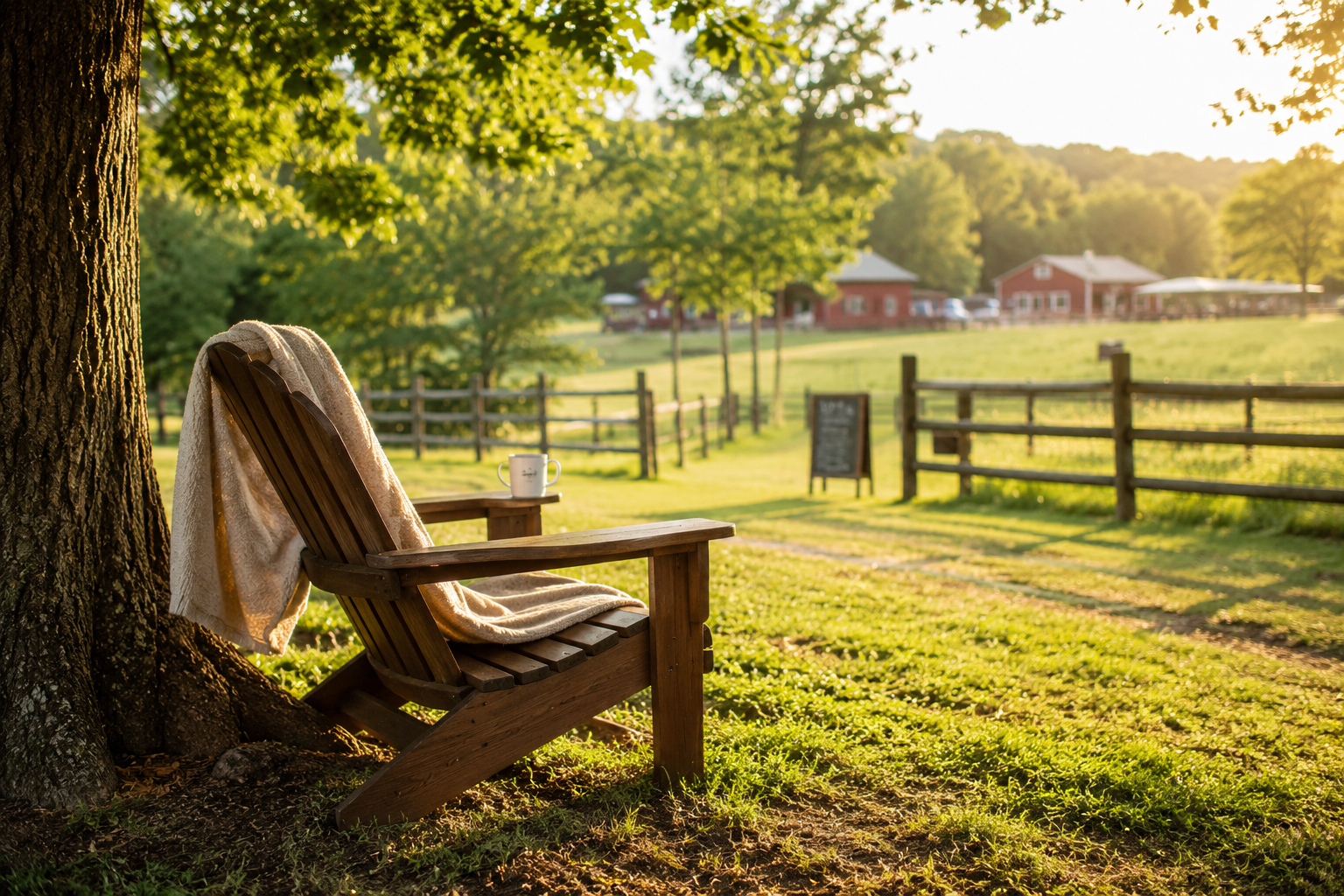
Maybe it’s a bench overlooking the pasture. Maybe it’s under a favorite tree at the edge of the property. Maybe it’s an old swing behind the barn where the breeze hits just right. The location itself matters less than the purpose behind it.
This space exists for one reason: recovery.
And here’s the important part — everyone on your farm knows what it means!!! If someone is in that spot, they are taking a moment to reset. Unless it’s truly urgent, they are not interrupted. No questions about parking. No “just one quick thing.” No discussing tomorrow’s schedule.
Because sometimes recovery isn’t a weekend away. Sometimes it’s ten quiet minutes behind the back pasture fence.
We often talk about burnout as if it appears suddenly, but in reality, it usually builds slowly. It’s the accumulation of long days, constant responsibility, decision fatigue, emotional labor, and the pressure to keep everything moving for employees, guests, and family. Agritourism operators carry a unique kind of weight because our work is deeply personal. We are not simply running businesses — we are sharing pieces of our lives, our land, and often our family traditions with the public every single day.
That level of visibility can be exhausting.
Creating a recharge spot will not eliminate stress entirely, but it creates something incredibly important: permission. Permission to pause before frustration turns into burnout. Permission to breathe before overwhelm takes over. Permission to step away for a few minutes and come back grounded instead of depleted.
And as leaders, we set the tone for what our teams believe is acceptable.
If employees only see leaders pushing through exhaustion without stopping, they learn that rest equals weakness. But when leaders model healthy pauses, emotional awareness, and sustainable work habits, it gives everyone else permission to care for themselves too.
That kind of culture matters. Especially in an industry built around caring for others.
Your recharge spot does not need to be elaborate. In fact, simple is often better. A chair. A shaded corner. A walking path. A place where you are not surrounded by unfinished tasks. Somewhere that reminds you there is still a world outside of stress and schedules.
And maybe this season, encourage your staff to find their own version too. Because protecting mental health on the farm is not just about responding when someone reaches a breaking point. It is about building small rhythms of recovery into the everyday life of your operation.
At NAFDMA, we know the demands of this industry are real, and so is the importance of caring for the people behind the experiences we create. If this season has felt heavier than usual, or if you or someone on your team could use additional support, we encourage you to explore our Mental Health Resources page. Sometimes the strongest thing we can do is recognize when we need support — and take the first step toward it.
RECENT ARTICLES