
Thoughts from the Board - Fitting into my Farm as the Inexperienced City Girl In-Law
Angie Day • January 28, 2026

Thoughts from the Board: Fitting into my Farm as the Inexperienced City Girl In-Law

Thanks to Laura Skelly, our NAFDMA Board Secretary for this week's message:


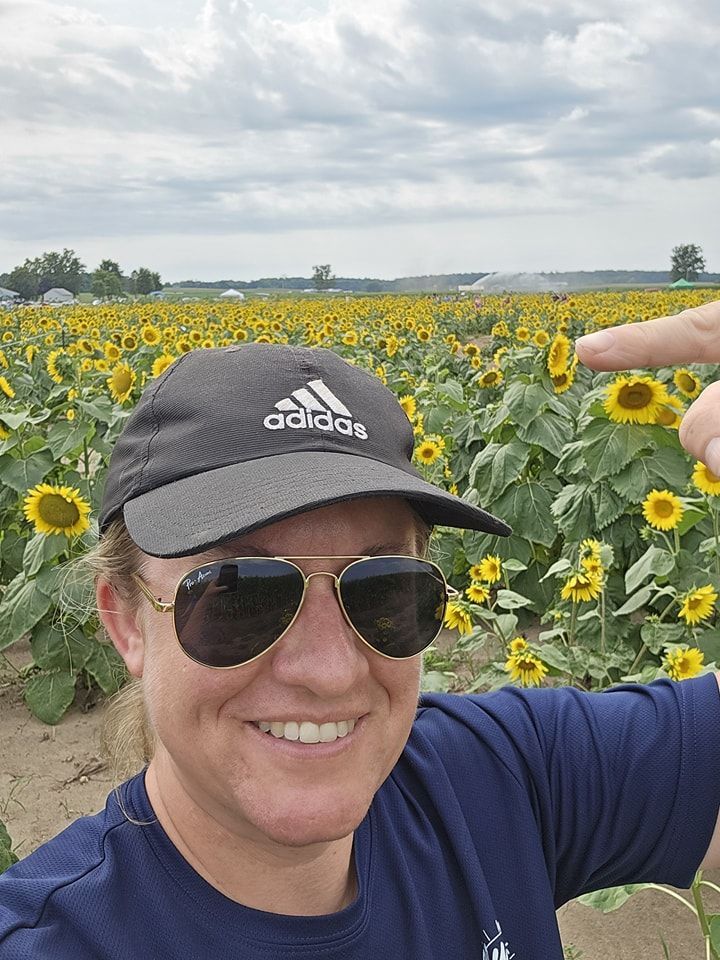
My name is Laura Skelly, and I’m one of the owners of Skelly’s Farm Market in Janesville, WI. That’s a sentence I never thought I’d write in my life.


I grew up in suburban Milwaukee County, which is about an hour and a half away from Janesville. I’m pretty sure I never saw a corn field until I was 18 (yeah, we didn’t travel much) and now I live in the middle of the corn belt.


I met Scott Skelly, my husband, my senior year in high school. He was pretty much a blind date to my senior prom because (I think) my best friend felt bad for me. She had a steady boyfriend for a while and I hadn’t dated anyone since my freshman year. Long story short, we started dating and developed a relationship that mainly took place on the phone after 9pm (because minutes were free after 9pm 😉). My senior year in college he proposed, I got my Bachelor’s degree, we got married, and the following year I graduated again with my Master’s degree in Meteorology. I had always wanted to be the one issuing tornado warnings and saving lives. Now, I order bakery supplies.


In 2013 there were hardly any jobs I wanted nearby. We were newlyweds and sick of driving back and forth visiting each other, and wanted to settle down. We bought a house in Janesville, where he’s worked on his family’s farm his whole life. I filled in from time to time when an employee called in sick but always told myself I could never work at the farm because I hated retail work. I did it all through high school and college and could never. Ha!


Six months into job searching, I felt useless, so I asked Scott if there would be room for me at the farm. We were growing and they needed someone to take over the bakery. Problem was, his family runs the business and I am by NO means qualified to take over something I don’t know ANYTHING about. I had zero managerial experience, have never been in charge of anything, and have always just been a good, reliable hourly worker who does the job that’s given to me.


So, I did what I knew I was good at – being put on a schedule. My first year on the farm I was on the regular employee schedule, doing regular things like cleaning bathrooms, mopping floors, doing dishes, etc. I had people I reported to and stood next to a cash register. I honestly don’t know if more than a handful of my co-workers knew I was even a Skelly. But that was okay with me! I was only 24, and I needed to sit back and observe something that Scott’s family had built from the ground up. Who would I be if I stepped in and said, “You should do this that way instead!”? I’m not gonna lie, I was extremely intimidated marrying into a family with a high reputation in town. My highest acclamation was being in the local newspaper for winning golf matches in high school – these people owned a BUSINESS!


After my first season, I started feeling more comfortable at the farm. I still didn’t feel comfortable enough to “officially” be in charge, but I took myself off the schedule and started taking on more responsibilities. I started learning how to place orders for bakery supplies. I started learning how to make employee schedules. I started learning how to drive a tractor. I started learning that hours as a farm market owner don’t run from 9am – 5pm Monday through Friday. I started learning that this job will eventually bring out the best in me. This job will push me to do things I never thought I’d be doing. This job will ultimately be what brings Scott and I even closer as husband and wife. People always ask us, “How do you work with your spouse every day? I’d kill them!” My question back to them is, “How do you not?” We get it and we get each other.


In my current role at the farm, I just finished my 11th season. I am the HR department, the schedule maker, the bakery manager, our website designer, the marketing manager, and I can plant sweet corn. I enjoy reading books about how to be a better boss. I enjoy watching teenagers grow with us each summer (even though they annoy me half the time, but I think they appreciate being here 😉). I enjoy teaching our 9-year old daughter that hard work pays off. I enjoy attending the annual NAFDMA conference because I enjoy learning how to be a better person for my staff and my in-laws.


Bottom line is – yes, I am the only in-law at the farm, but there’s room for you if you want it and your spouse’s farm wants it. I slowly made my way into their business lives and wasn’t just the daughter-in-law or sister-in-law. I am an equal now. The intimidation slowly wore off but it’s definitely still there. The feeling is still in the back of my mind that I have to prove myself that I belong here. I’m not really sure why, but it’s there. I think it really grounds me so I remember that I am not the one who started this – I am just taking what they built and adding another layer of foundation.


RECENT ARTICLES
By angie January 28, 2026
Too often, unique, high-value seasonal items remain lost on shelves, unable to compete with the sheer volume of surrounding jars and packages in a sea of monotony. Identify one " sleeper product " each season—a special jam, a gourmet baking mix, a heritage squash variety—and give it the dedicated display it deserves. The Opportunity: When you isolate a single item and present it powerfully, you create exclusivity, rarity, and urgency . This strategy focuses the customer's buying energy on a high-margin, seasonally relevant star . Actionable Tip: Create a monumental feature display for that one product, ideally placed at the store entrance or in a highly trafficked area. Use dramatic height, premium signage that tells the product’s unique story (e.g., "The Forgotten Heirloom: Our Great-Grandmother's Winter Squash"), and focused lighting . On a smaller scale, highlighting a niche item on a dedicated, small table can raise awareness and encourage impulse buying. By giving a single product this "shout-out" moment, you transform it from a commodity on a shelf into a must-have seasonal treasure .
January 26, 2026
Creating the design for the Cove Playground at the National Maritime Museum was a different experience for us. We are no strangers to inclusive play with Windsor , Boundless and Blenheim under our belt already. In this project, we were given the opportunity to work with some local stakeholders to fully understand what would make a new adventure play area properly accessible. By the time the design was finished, we had spent more than 100 hours in consultation with over 200 individual stakeholders from local SEND schools and groups, to help design the play they had always dreamed of being able to enjoy. The stakeholder engagement touched every part of the design on the micro and macro scale. Wide design themes such as number, characteristics and location of access points to site, right down to the smallest finishing touches. We baked their thinking into the fabric of the playground from the get go, making the SEN features coherent and part of the narrative of the play, rather than adding it as a second thought. At the recent opening event, some of the children from Willow Dene School were tasked with cutting the ribbon to declare the play open, as a thank you for their invaluable input. There were speeches too, but the one that stood out was by Lisa Parascandolo from Willow Dene, which we reprint here in full. "Willow Dene school is a special needs school with students ranging from 2-19, with cohorts of children and young people with complex needs and autism. We are so used to being unseen. Or if we are seen, it is in a “less than” capacity. That our children and young people do not have opinions or cannot express what they want or need. To be included in this whole process, not just as a tick box exercise, add an accessible swing here, an inclusive roundabout there…an afterthought, but to be asked what we wanted, what would we like to have in a play space, how do our children play. It was truly remarkable. We often do not get to talk about our children in this way, for the families, children and staff to openly discuss what we need to help assist with play. We were able to raise wanting to use all our senses within play, to be able to discover our vestibular sense and develop our proprioceptive sense. And the wonderful experience of being heard. We discussed the wheelchair accessible ramp having ‘passing places’ and the architects getting to understand why that was important and then putting that into the design. When the only people that usually take the time to understand what you need are your family and your teachers, it’s almost a euphoric experience to have these conversations. I was fortunate to have a walk around the site yesterday and it is truly amazing to see something come to life from all the drawings and concepts we have been involved with. Initially for our families, it was that feeling of being included and not as an afterthought. For them to talk about their child and to feel heard. To discuss how important it is to have inclusive and accessible play spaces. Families come in all shapes and sizes. Being part of a disabled family and being able to take the whole family to one play space and interact with others is quite remarkable, as it is not able to happen very often. With this play space, our families can feel like part of the community, meet up with friends and feel a sense of belonging. A short walk from the play space is the museum café. There is also a changing places hygiene unit with a hoist, which any parent of a child who uses a wheelchair will tell you, is absolutely essential in planning any day out. We can fight prejudices about disability by being out in the community and by being seen. Though we might look and sound different we are still children, who love to play. And now they have a place in our community that they helped create and it is beautiful." Lisa Parascandolo Physical Development and MOVE Lead Cultural Capital Lead Willow Dene School Sarah Lockwood, Head of Engagement at Royal Museums Greenwich initiated the consultation process and we worked with Ruth Boley, Senior Manager; Learning, Ros Croker-Ahmed, Senior Manager; Partnerships and Engagement and Katie Cassel; Families and Young People Manager to engage and facilitate working with stakeholders, which for us delivered incredible results we can all be proud of. Speaking about it, Sarah said - "At Royal Museums Greenwich we take play seriously and wanted the opportunity of creating a new outdoor play space, at the National Maritime Museum, to support every child’s right to play. Working collaboratively is at the heart of what we do, and we thank CAP.Co for undertaking the journey of consultation with our stakeholders, listening and responding to their needs, to make a truly unique and memorable space for children and their families." Lisa's speech at the opening of the Cove was the most incredibly moving speech for all of our team. What we learned during the process of co-creating the design will change the way we work on every project we look at going forwards. We have always believed that play is better together. In fact it's only really fun if you're playing and interacting with others. Working with a client as forward-thinking as Royal Museums Greenwich enabled this process to be genuinely useful and between us, we have created something amazing. Inclusive play is incredible. Children don't see disabilities, they see that we have created the ability to play together with everyone, whatever their ability. To be truly inclusive, everyone must come away with the same play experience, which means a playground should offer a level of challenge to ALL abilities including SEN users. The full list of Royal Museums Greenwich stakeholders who were consulted to create the play at the National Maritime Museum is as follows: - Action For Refugees Lewisham - Museum Participants/Groups: Discover Sundays, LGBTQ+ Family Forum, Play Outdoors, SENsory Sailors - Primary Schools: Halstow, James Wolfe, Mulgrave, Meridian, Myatt Garden - The Anchor SEND friendly Center and Willow Dene Special School And Thank you to Lucy MacDonald who supported the consultation process across the groups.  Royal Museums Greenwich have created a Play Manifesto to reinforce the commitment to actively supporting play. You can see that here .
By angie January 19, 2026
Retail Tricks! One retail trick which is frequently overlooked is the benefit of having complementary items for your produce/products on hand and easy for customers to purchase. If customers can get everything they need to use what you grow on the farm, they are more likely to purchase more of it. Examples include Rada Cutlery, as detailed more below. But it can also include pumpkin carving tools, spice or dip mixes to cook meals, vases for the flowers which are picked, and/or reusable bags to carry it all home.  Boosting Sales One of the easiest ways to boost Rada Cutlery sales is to use it where your visitors can see it in action. Whether you’re slicing fresh apples, cutting cheese, or spreading homemade jam, make sure you’re using Rada knives, peelers, or spreaders — and point it out! “We use Rada Cutlery here — it’s 100% made in the USA since 1948. You can grab one right over there!” When guests watch you easily peel produce or slice cleanly with a Rada knife, it builds trust and interest. Demonstrating the product in real-time not only increases interest but also drives impulse purchases. For this reason, we recommend keeping the featured products close to the sampling area. And placing additional products in several complimentary locations throughout the store, such as a clip strip of peelers and paring knives next to the apples. Another recommendation would be to place items in the impulse areas and near the checkout with clear signage and pricing.